
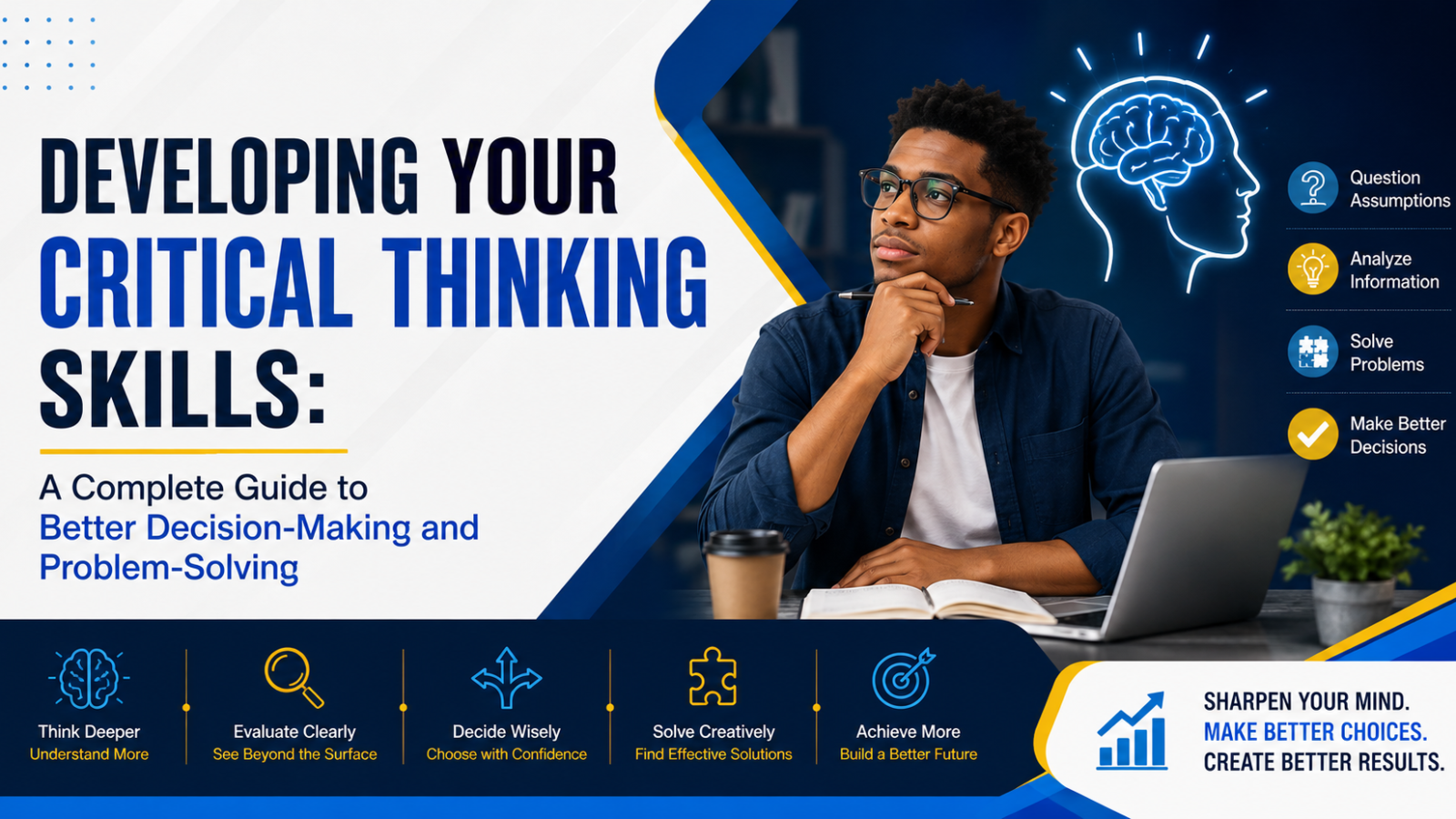
Introduction
In today’s fast-paced world, information is everywhere. Every day, people are exposed to news, opinions, advertisements, social media posts, and countless decisions that require careful judgment. The ability to think critically has become one of the most valuable skills for students, professionals, entrepreneurs, and leaders.
Critical thinking is more than simply being intelligent or knowledgeable. It is the ability to analyze information objectively, evaluate evidence, question assumptions, and make well-informed decisions. Individuals with strong critical thinking skills are better equipped to solve complex problems, communicate effectively, avoid costly mistakes, and succeed in both their personal and professional lives.
This guide explores what critical thinking is, why it matters, and practical strategies you can use to strengthen your critical thinking skills every day.
What Is Critical Thinking?
Critical thinking is the process of carefully analyzing information before accepting it as true or making decisions based on it. It involves logical reasoning, curiosity, evidence-based evaluation, and open-mindedness.
Critical thinkers do not accept claims simply because they are popular or come from authority figures. Instead, they ask questions, seek evidence, consider multiple perspectives, and arrive at reasoned conclusions.
Critical thinking combines several important skills, including:
- Observation
- Analysis
- Logical reasoning
- Interpretation
- Problem-solving
- Decision-making
- Reflection
- Communication
These skills work together to help individuals make better judgments in all areas of life.
Why Critical Thinking Is Important
Developing strong critical thinking skills offers numerous benefits.
Better Decision-Making
Critical thinkers evaluate facts before making choices. This reduces emotional decision-making and leads to better outcomes.
Improved Problem-Solving
Complex problems often require creative and logical solutions. Critical thinking helps identify the root causes of problems instead of treating symptoms.
Stronger Communication
People who think critically present clear arguments supported by evidence, making them more persuasive and effective communicators.
Greater Independence
Critical thinkers rely on evidence and reasoning rather than blindly following popular opinions or misinformation.
Career Success
Employers value employees who can analyze situations, solve problems, and make informed decisions independently.
Characteristics of a Critical Thinker
Successful critical thinkers often demonstrate the following qualities:
- Curiosity
- Open-mindedness
- Intellectual humility
- Logical reasoning
- Fairness
- Patience
- Self-discipline
- Willingness to change opinions when evidence changes
- Strong observation skills
- Respect for facts over assumptions
These characteristics help people navigate uncertainty and make thoughtful decisions.
The Critical Thinking Process
Critical thinking follows a structured process.
Step 1: Identify the Problem
Clearly define the issue or decision that needs attention.
Ask yourself:
- What exactly is the problem?
- Why does it matter?
- What outcome am I trying to achieve?
A clearly defined problem is easier to solve.
Step 2: Gather Information
Collect reliable and relevant information from multiple credible sources.
Consider:
- Research
- Statistics
- Expert opinions
- Personal observations
- Customer feedback
- Historical data
Avoid relying on a single source whenever possible.
Step 3: Analyze the Evidence
Examine the quality and reliability of the information.
Ask questions such as:
- Is this information supported by evidence?
- Is the source trustworthy?
- Are there biases?
- What information might be missing?
Strong conclusions require strong evidence.
Step 4: Consider Different Perspectives
Effective critical thinkers explore alternative viewpoints before making decisions.
Ask:
- What would someone who disagrees say?
- Are there other possible explanations?
- What assumptions am I making?
Considering multiple perspectives leads to more balanced conclusions.
Step 5: Evaluate Possible Solutions
List potential solutions and compare their advantages and disadvantages.
Think about:
- Costs
- Risks
- Benefits
- Long-term consequences
- Practicality
Choose the option that provides the greatest overall value.
Step 6: Make a Decision
After careful evaluation, make the best decision based on the available evidence.
Remember that no decision is perfect. The goal is to make the most informed choice possible.
Step 7: Reflect on the Results
After implementing your decision, evaluate the outcome.
Ask yourself:
- Did the solution work?
- What could have been improved?
- What lessons did I learn?
Reflection strengthens future decision-making.
Common Barriers to Critical Thinking
Many factors can interfere with objective thinking.
Confirmation Bias
People naturally seek information that supports what they already believe while ignoring evidence that contradicts it.
Emotional Decision-Making
Strong emotions such as fear, anger, or excitement can cloud judgment.
Peer Pressure
Following the crowd without independent analysis can lead to poor decisions.
Overconfidence
Believing you already know enough may prevent you from seeking additional information.
Lack of Information
Incomplete or inaccurate data often leads to weak conclusions.
Recognizing these barriers is the first step toward overcoming them.
Practical Ways to Improve Critical Thinking Skills
Developing critical thinking is a lifelong process. Here are practical ways to strengthen it.
Ask Better Questions
Instead of accepting information at face value, ask:
- Why?
- How?
- What evidence supports this?
- Is there another explanation?
- What assumptions are being made?
Good questions lead to better understanding.
Read Widely
Expose yourself to different viewpoints by reading:
- Books
- Academic articles
- Industry reports
- Reputable news sources
- Biographies
- Research papers
Reading broadly expands your perspective.
Practice Active Listening
Listen carefully before responding.
Focus on understanding rather than preparing your reply.
Good listeners often become better thinkers.
Solve Complex Problems
Challenge yourself with activities such as:
- Business case studies
- Strategy games
- Chess
- Puzzles
- Brain teasers
- Data analysis
- Real-world projects
These activities improve logical reasoning.
Learn to Recognize Bias
Everyone has biases.
Ask yourself:
- Am I being objective?
- Am I ignoring conflicting evidence?
- Am I making assumptions without proof?
Awareness helps reduce biased thinking.
Keep a Decision Journal
Record important decisions along with:
- The information available
- Your reasoning
- Expected outcomes
- Actual results
Reviewing past decisions helps improve future judgment.
Discuss Ideas with Others
Constructive discussions expose you to new perspectives and challenge your thinking.
Respectful debate often leads to deeper understanding.
Critical Thinking in the Workplace
Employers highly value critical thinking because it improves performance across many roles.
Professionals use critical thinking to:
- Solve customer problems
- Improve business processes
- Analyze financial data
- Manage projects
- Resolve workplace conflicts
- Evaluate risks
- Make strategic decisions
- Lead teams effectively
Organizations with strong critical thinkers are often more innovative and adaptable.
Critical Thinking for Students
Students can strengthen critical thinking by:
- Asking questions in class
- Evaluating sources before citing them
- Participating in debates
- Conducting research
- Solving real-life case studies
- Reflecting on feedback
- Writing analytical essays
Critical thinking improves academic performance and prepares students for future careers.
Critical Thinking for Entrepreneurs
Entrepreneurs face uncertainty every day.
Critical thinking helps business owners:
- Identify market opportunities
- Evaluate business risks
- Understand customer needs
- Analyze competitors
- Manage finances
- Develop marketing strategies
- Make investment decisions
- Adapt to changing markets
Strong critical thinking often distinguishes successful entrepreneurs from those who struggle.
Daily Habits That Strengthen Critical Thinking
Develop these habits consistently:
- Read something educational every day.
- Question assumptions respectfully.
- Verify facts before sharing information.
- Reflect on your decisions.
- Welcome constructive criticism.
- Stay curious.
- Learn from mistakes.
- Seek evidence before forming conclusions.
- Practice patience when solving problems.
- Keep an open mind.
Small daily improvements can lead to significant long-term growth.
Common Mistakes to Avoid
Avoid these habits that weaken critical thinking:
- Jumping to conclusions
- Believing everything you read online
- Ignoring evidence that challenges your views
- Making decisions based only on emotions
- Refusing to admit mistakes
- Following popular opinions without analysis
- Assuming correlation means causation
- Rushing important decisions
Recognizing these mistakes makes it easier to avoid them.
Final Thoughts
Critical thinking is one of the most valuable skills you can develop in the modern world. It empowers you to make informed decisions, solve problems effectively, communicate clearly, and navigate complex situations with confidence.
Like any skill, critical thinking improves through consistent practice. By asking thoughtful questions, evaluating evidence carefully, considering different perspectives, and reflecting on your experiences, you can strengthen your ability to think independently and make better decisions in every aspect of life.
Whether you’re a student preparing for your future, an entrepreneur growing a business, or a professional advancing your career, investing in your critical thinking skills will provide lasting benefits and help you succeed in an increasingly complex world.